Si prefieres escuchar, te dejo también la versión en Spotify.
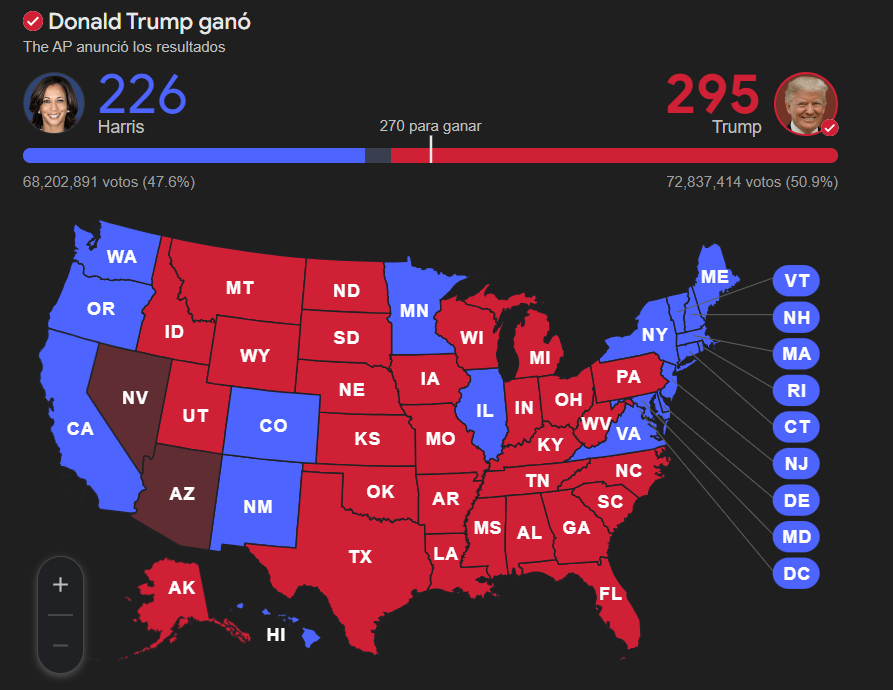
Debo empezar por contradecirme. Y digo esto porque, si nos movemos en el escenario de las estadísticas y los votos, Trump, a fecha de hoy, apunta a renovar esos 74 millones de votos que obtuvo en 2016. Sin embargo, Kamala parecería obtener solamente 68 millones de votos, es decir, 13 millones menos que los 81 millones que obtuvo Biden en 2020. Hechas las sumas y las restas, deberíamos concluir en que Kamala perdió las elecciones, generando muchos menos votos que los que consiguió Biden, frente a un voto duro de Trump que se ha mantenido, tal cual fuera en su victoria de 2016.
Dicho esto, lo que a mi parecer ocurrió es que Trump ganó las elecciones por mérito propio. Y ese mérito radica en el hecho de haber conseguido consolidar un público objetivo, unos seguidores, unos fans en realidad, que verdaderamente se identifican con él. El votante de Trump es como Trump. Por eso es por lo que, temas como el juicio por tocamientos indebidos, los pagos a una prostituta para guardar silencio sobre su infidelidad, la funesta toma del Capitolio, los juicios por sobrevaloración de propiedades y tantas otras cosas más, terminaron no solo siendo irrelevantes, sino que se convirtieron en motivos perfectos para ser considerados como una supuesta batalla de acoso contra el multimillonario. De victimario a víctima. Y claro, el fallido intento de asesinato terminó por redondear esa figura. En la misma línea, el discurso supremacista, racista, matonesco, misógino y demás que lo caracteriza, pareciera, por el reflejo de los votos, que es un discurso que hoy también se practica en gran parte de las calles de los Estados Unidos.
Ahora bien, ese votante duro pareciera no se sentirse del todo orgulloso de su candidato, hoy presidente electo. Según muchas encuestas de las encuestas emitidas por medios respetables (The Washington Post, The New York Times, The Economist, entre otros), Kamala tenía ciertas probabilidades de ganar. Sin embargo, no solo no las tuvo, sino que la victoria del Partido Republicano ha sido aplastante, teniendo hoy el control del Ejecutivo, Senado, Congreso y Corte Suprema. Entonces, ¿cómo es que las encuestas más serias vaticinaban otros resultados y se dio esta paliza a los Demócratas? En definitiva, porque algunos millones de votantes no querían admitir que votarían por Trump, el voto oculto. Voto por ti, pero me da verguenza decirlo.
Pero volviendo al voto duro, vemos también otras grandes inconsistencias. Entre las ideas fuerza de la campaña de Trump, encontré una que particularmente me llamó mucho la atención: el proteccionismo arancelario. Una política que es abiertamente contraria al libre mercado, y que me recuerda claramente a Alan García I y esa funesta política de proteccionismo. Así las cosas, hoy el votante de la derecha conservadora resulta ser menos «de derecha», o por lo menos, algo menos liberal, aunque no sean conscientes de ello. Lo mismo ocurre con respecto a sus políticas migratorias, abiertamente contrarias al galopante proceso de globalización. Resulta curioso cómo, en esta nueva era de las «ex-ideologías», uno puede autodefinirse como de derecha, pero proponer políticas públicas de izquierda y ganar. Pero así estamos, y por eso llevo mucho tiempo hablando del fin de las ideologías y el inicio de un nuevo orden basado en conservadurismo y progresismo.
En resumidas cuentas, la fuerte identificación del votante con su candidato fue, para mí, una clave del éxito de esta campaña. Muy por el contrario, lo que sucede con los Demócratas es que, su votante, recibe lo que le toca en términos de candidaturas; no necesariamente se siente representado, y termina emitiendo un voto para evitar que gane el «enemigo», pero no para que gane su verdadero candidato. Ahí radica una gran debilidad del Partido Demócrata en los últimos años: la ausencia de un candidato que verdaderamente represente a sus votantes y que no permita que pasen de 81 a 68 millones. Si hoy preguntáramos en cualquier lugar del mundo quién representa al Partido Republicano de los Estados Unidos, creo sin miedo a equivocarme, que una gran mayoría de personas diría que Donald Trump. Si hacemos la misma pregunta con respecto al Partido Demócrata, dudo que haya grandes coincidencias en las respuestas. Unos dirán que Obama, que los Clinton, que Biden o quizá Kamala, pero no hay una figura que se mimetice con la marca, con el Partido.
Mención aparte merece el apoyo de Elon Musk, una muestra clara de la enorme influencia de los nuevos paradigmas de la sociedad. Pero eso es harina de otro costal.
El hecho ahora es que Trump es nuevamente el máximo representante de los Estados Unidos, con todo lo que ello significa, para bien o para mal.
Derechos de Imagen: Associated Press.
English Version
Kamala doesn’t lose, Trump wins
I must begin by contradicting myself. And I say this because, if we look at the statistics and votes, Trump today seems poised to renew the 74 million votes he got in 2016. However, Kamala appears to be receiving only 68 million votes, which is 13 million fewer than the 81 million Biden received in 2020. After adding and subtracting the numbers, we should conclude that Kamala lost the election, generating far fewer votes than Biden, against a loyal Trump voter base that has remained steady, just as it was in his 2016 victory.
That being said, what I believe happened is that Trump wins the election on his own merit. And that merit lies in the fact that he has managed to consolidate a target audience, followers—true fans, actually—who really identify with him. The Trump voter is like Trump. This is why issues like the groping trial, the payments to a prostitute to silence her about his infidelity, the disastrous Capitol riot, the lawsuits for property overvaluation, and many others ended up not only being irrelevant but also became perfect excuses to be seen as part of an alleged harassment campaign against the billionaire. From villain to victim. And of course, the failed assassination attempt rounded out that figure. Similarly, the supremacist, racist, bullying, misogynistic rhetoric that characterizes him seems, based on the reflection of the votes, to be rhetoric that is also practiced on many of the streets of the United States today.
That said, this hardcore voter doesn’t seem to be entirely proud of their candidate, the newly elected president. According to many reputable media polls (The Washington Post, The New York Times, The Economist, among others), Kamala had a certain chance of winning. However, not only did she not have those chances, but the Republican victory has been crushing, with control of the Executive, the Senate, Congress, and the Supreme Court. So, how is it that the most serious polls predicted other outcomes and yet the Democrats were handed such a defeat? In the end, it’s because millions of voters didn’t want to admit they were voting for Trump—the hidden vote. «I vote for you, but I won’t say it out loud.»
But returning to the hardcore vote, we also see other big inconsistencies. Among Trump’s key campaign ideas, I found one that particularly caught my attention: tariff protectionism. A policy that is openly contrary to the free market, and that clearly reminds me of Alan García I and his disastrous protectionist policies. That said, today the conservative right voter seems less «right-wing,» or at least somewhat less liberal. The same applies to his immigration policies, which are openly opposed to the ongoing process of globalization. It’s curious how, in this new era of the «post-ideologies,» one can define themselves as right-wing but propose left-wing public policies and still win. But that’s where we are, and that’s why I’ve been talking for a long time about the end of ideologies and the beginning of a new order based on conservatism and progressivism.
In summary, the strong identification of the voter with their candidate was, to me, a key to the success of this campaign. On the contrary, what happens with the Democrats is that their voter gets what they’re given in terms of candidacies; they don’t necessarily feel represented and end up casting a vote to prevent the «enemy» from winning, but not for their real candidate to win. This is a major weakness of the Democratic Party in recent years: the absence of a candidate who truly represents their voters and prevents the vote count from dropping from 81 to 68 million. If we were to ask anywhere in the world today who represents the Republican Party of the United States, I’m confident that a vast majority would say Donald Trump. If we asked the same question about the Democratic Party, I doubt there would be much consensus in the responses. Some would say Obama, others the Clintons, some might say Biden or even Kamala, but there is no figure who fully embodies the brand, the Party.
A special mention should be made of Elon Musk’s support, a clear example of the enormous influence of the new societal paradigms. But that’s a different story. The fact now is that Trump is once again the supreme representative of the United States, with all that that implies, for better or worse.

 Café para Cuatro